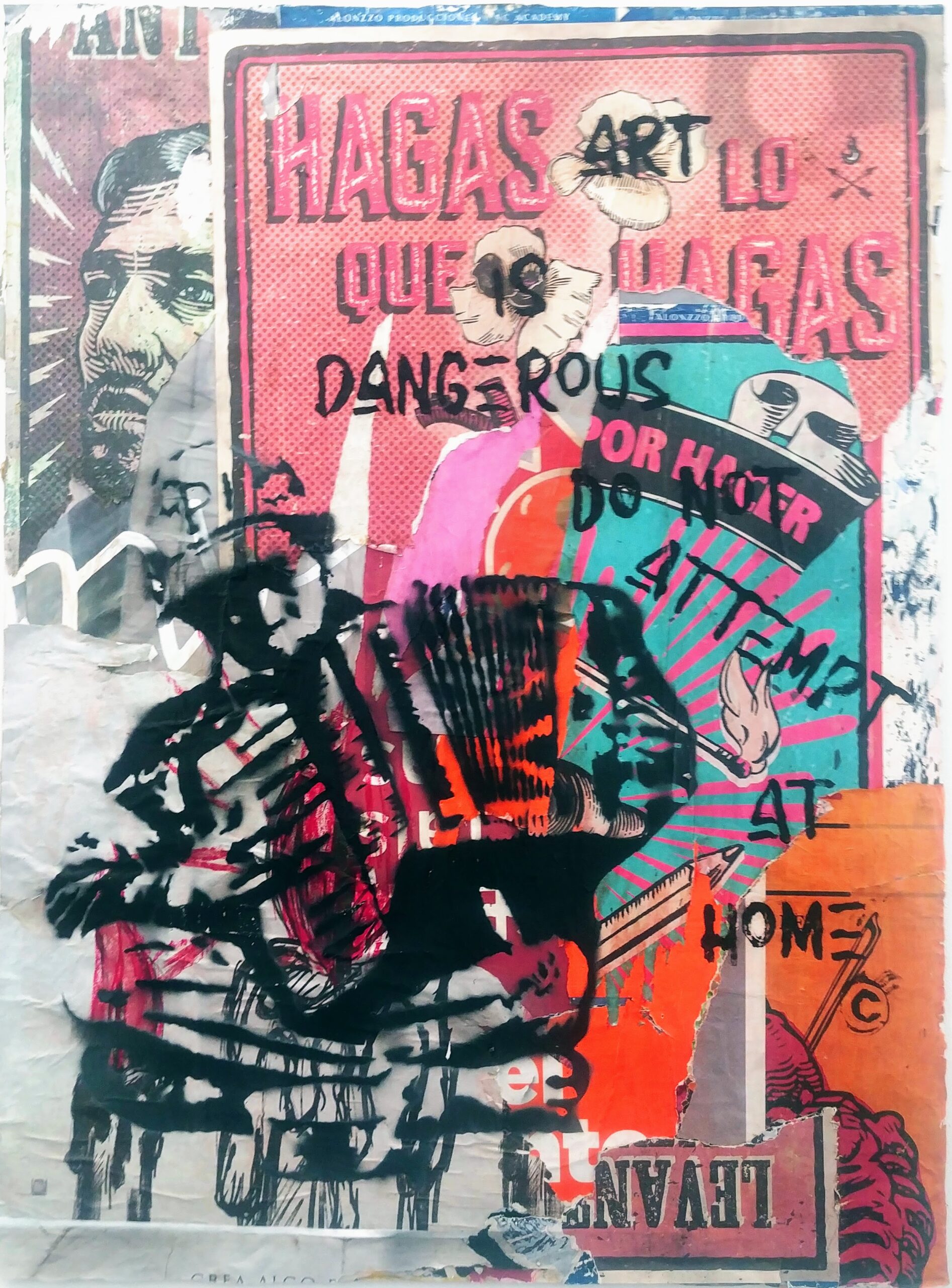
Art Is Dangerous by Borna Libertines is a 2023 street art collage on cardboard that merges pop culture, graphic design, and rebellion. The bold typography and ripped posters declare creative defiance, transforming any room into a space of unapologetic energy. 76×103cm. Price on request.
2023 · Street Art
Art Is Dangerous
Add a touch of elegance to your home with a stunning statement piece for any collector. Bold, rebellious, and unforgettable — this work challenges you to embrace the unconventional.
"Art Is Dangerous" is a bold and dynamic collage that merges elements of street art, pop culture, and graphic design into a single, arresting composition. The central focus lands on striking textual declarations — "HAGAS LO QUE HAGAS" and "DANGEROUS" — phrases that immediately establish a tone of defiance and unapologetic risk-taking. These words are not merely decoration; they are the manifesto at the heart of the work, commanding the viewer's attention before anything else does.
The vibrant palette — red, pink, green, orange, contrasting black and white — creates a visually explosive tension. Layers of ripped and collaged poster fragments are overlaid with gestural spray paint, producing a surface that feels simultaneously chaotic and intentional. Faces emerge from the noise, abstracted yet recognizable, evoking the anonymous individuals of urban life caught between the messages that surround them every day.
Built on cardboard with spray paint and collaged ripped posters, this piece carries the raw materiality of the streets themselves — salvaged, repurposed, and given new meaning. The result is a work that transforms any space it inhabits, sparking conversations, provoking thought, and inspiring viewers to embrace ideas that sit outside the expected and the comfortable.
Street Art & Post-Graffiti
- Ripped poster collage technique — a direct descendant of wheat-paste street culture — gives the work its layered, weathered visual archaeology
- Spray paint over collage creates spontaneous gestural marks that disrupt and animate the underlying typography and imagery
- The raw cardboard surface reinforces the urban, found-material aesthetic, rooting the work firmly in street art tradition
Pop Art Influence
- Bold, graphic typography used as both visual and conceptual element, in the lineage of Warhol, Lichtenstein, and Basquiat
- Vibrant, high-contrast color palette borrowed from commercial printing and mass-media imagery, then subverted through layering and distortion
- Appropriated pop culture imagery — faces, logos, poster fragments — reassembled to generate new meaning through juxtaposition
Graphic Design as Art Language
- Strong typographic hierarchy — oversized text anchors the composition while smaller fragments create rhythmic counterpoints
- The interplay of legible and illegible text layers mirrors information overload in contemporary visual culture
- Collage composition balances asymmetry and visual weight with an instinctive graphic sensibility
Mixed Media & Texture
- The collision of printed ephemera, hand-applied spray, and raw substrate creates tactile depth impossible to achieve in digital or single-medium work
- Torn edges and overlapping layers introduce three-dimensional texture and a sense of evolving, accumulative creation
What This Artwork Evokes
- An immediate jolt of energy — the work demands to be looked at, refusing passivity from the moment it enters your field of vision
- The spirit of urban streets: layered, loud, saturated with competing voices, yet somehow coherent and alive
- A questioning of creative boundaries — the phrase "Dangerous" asks: dangerous to whom? What exactly is threatening about making art?
- A sense of solidarity with those who create outside sanctioned spaces and against the grain of expectation
How It Enhances a Space
When placed in a home, studio, or gallery, "Art Is Dangerous" becomes a conversation that never stops. It shifts the energy of any room — injecting colour, motion, and conceptual weight where there was stillness. It signals something about the collector: a willingness to challenge the expected, to live alongside ideas that push back. This is not background decoration; it is a presence.
Dialogue It Opens
- Why do we label certain forms of expression as dangerous — and who benefits from that label?
- How does the appropriation of commercial imagery become a form of protest or reclamation?
- What is the relationship between rebellion and creativity, and can one truly exist without the other?
Rebellion and Defiance
The dominant emotional register of this work is one of refusal — refusal to be quiet, refusal to conform, refusal to make art that does not challenge. The bold typography acts as a battle cry, and the spray paint gestures as a physical enactment of that defiance. Standing before this piece, you feel the charge of someone who decided the rules did not apply.
Creative Daring
There is a particular energy that comes from watching someone risk — risk failure, risk misunderstanding, risk the judgement of others — in service of making something honest. "Art Is Dangerous" radiates that energy. It feels like an act committed rather than an object carefully constructed, and that urgency is infectious.
Urban Vitality and Movement
The layered collage fragments, the explosive colour, the competing voices of text and image — everything in this work is in motion. It evokes the relentless pulse of city life: overlapping, loud, often contradictory, yet generating a kind of beauty that emerges precisely from that chaos rather than despite it.
Empowerment and Invitation
"HAGAS LO QUE HAGAS" — whatever you do — is ultimately an affirmation. Do it. Make it. Be dangerous in your creativity. The work does not merely document rebellion; it extends an invitation to the viewer to participate in it, to carry something of its spirit out of the gallery and into their own life and making.
Tension and Release
The contrast between the vibrant, almost aggressive palette and the layered, accumulated texture of ripped materials creates a productive visual tension — the sense that this composition is barely contained, that it could keep expanding indefinitely. That tension is also a kind of release: the pleasure of witnessing something uncaged.