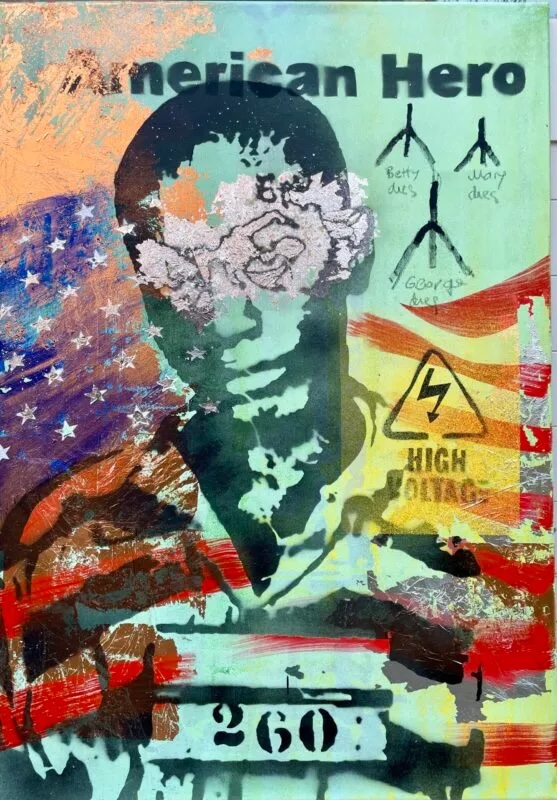
American Hero by Borna Libertines is a 2024 mixed-media street art painting memorializing George Stinney Jr., the youngest person executed in the U.S., while critiquing racial injustice, historical erasure, and the broken American Dream. Neon palette, gold & silver leaf on canvas. $1,900. 70×100cm.
2025 · Social Justice Street Art
American Hero
Injustice, The American Dream vs. Reality, Erasure & Forgotten History, Resistance & Protest
- American Hero, does more than tell a story—it demands reflection and emotional engagement. The bold textures, layered symbolism, and electrifying colors create a visceral impact, evoking feelings of sorrow, outrage, and urgency. This piece doesn't just depict history; it challenges viewers to confront uncomfortable truths about justice, racial inequality, and power. The contrast between patriotic elements, such as the American flag, and the haunting imagery of execution creates a striking tension, making it an arresting centerpiece in any space. Displaying an American Hero in a home, gallery, or public setting transforms the environment into one of deep contemplation and social awareness. It invites conversation, encourages historical reflection, and serves as a visual protest against systemic injustice—ensuring that George Stinney Jr.'s story is neither forgotten nor repeated.
Mixed-Media Composition
: The painting combines stencil work, abstract textures, collage elements, and hand-drawn illustrations to create a layered, multidimensional effect. The rough textures and distressed areas evoke a sense of history, struggle, and decay—symbolizing the injustice faced by George Stinney Jr.
Street Art & Stencil Techniques
: The bold stenciled text and high-contrast portrait pay homage to street artists like Banksy and Shepard Fairey, using their graphic approach to amplify a powerful social message. The number "260" (likely referencing an inmate number) and warning symbols intensify the sense of institutional oppression.
Protest & Political Art Influences
: Similar to works by artists like Emory Douglas (Black Panther Party) or Barbara Kruger, American Hero uses striking visual elements to critique injustice. The chaotic mix of colors, rough textures, and disruptive overlays reflect the turbulence and violence of an unjust system.
Symbolic Use of the American Flag
: The fragmented American flag elements—distressed, layered, and partially obscured—challenge the idea of justice and equality in the U.S. This creates a stark contrast between national pride and the reality of systemic racism.
Emotional & Conceptual Depth
: The electrifying yellow "High Voltage" symbol references the execution method, reinforcing the brutality of Stinney’s fate. The silver leaf over his face suggests erasure, loss of identity, or the fading memory of his story in mainstream history.
Emotions/Themes
: Sorrow & Grief – The tragic story of George Stinney Jr. is deeply felt through the haunting imagery and distressed textures. The piece serves as a painful reminder of a young life unjustly taken. Anger & Outrage – The stark contrast of patriotic symbols with execution-related imagery provokes a sense of injustice, urging viewers to confront uncomfortable truths about systemic racism and judicial failures. Shock & Unease – The electric chair reference, eroded facial details, and ominous warnings create a feeling of dread, forcing viewers to engage with the gravity of capital punishment and racial injustice. Empathy & Mourning – Despite the heavy subject matter, the artwork humanizes Stinney’s story, evoking compassion for victims of wrongful convictions and racial discrimination. Call to Action & Reflection – American Hero is not just a historical commentary—it demands that viewers examine modern injustices and question how far we have truly come.
Themes Explored
: Injustice & Racial Inequality – The wrongful execution of a Black child in a biased legal system highlights the failures of justice, past and present. State Violence & Capital Punishment – The presence of the “High Voltage” symbol and prison references critique the brutality of the death penalty. The American Dream vs. Reality – The fragmented American flag suggests a broken promise of freedom and equality, contrasting national ideals with historical oppression. Erasure & Forgotten History – The obscured face represents how marginalized stories are often erased from collective memory, reinforcing the need to remember and honor the past. Resistance & Protest – By bringing visibility to this injustice, the painting becomes an act of protest, encouraging dialogue about systemic racism and the fight for true equality. This artwork is not just a piece to admire—it’s a statement that lingers in the mind, sparking conversations about justice, history, and accountability.