2024 · Street Art
Dead Man In The Room
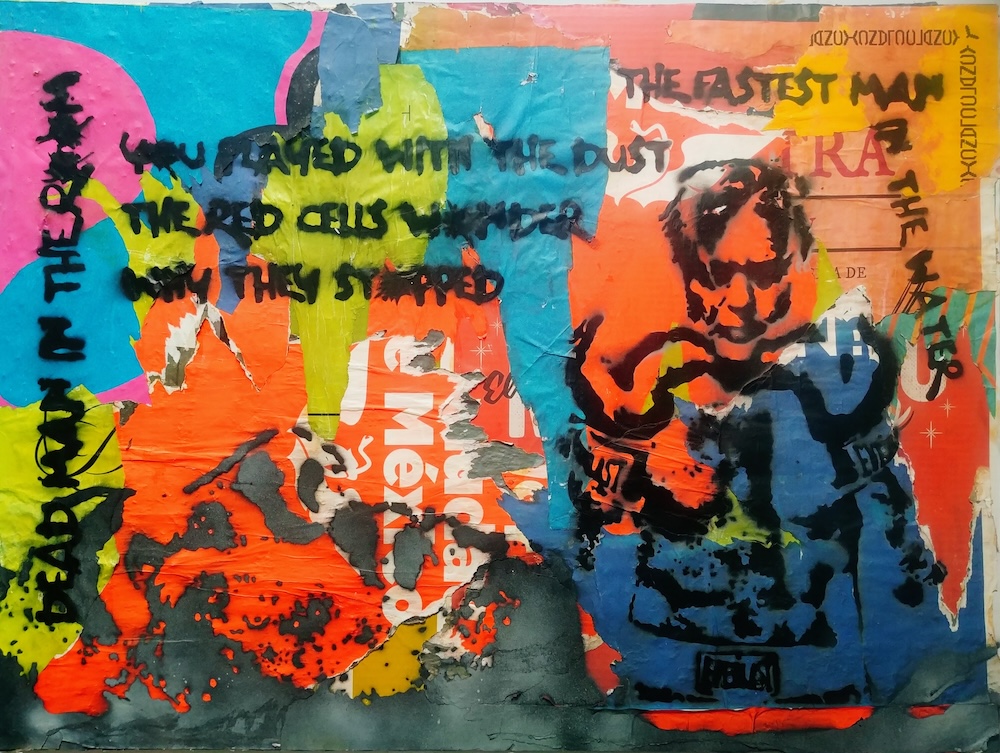
"Dead Man In The Room" is a raw and confrontational mixed-media artwork that addresses addiction, mortality, and the often-invisible crisis of overdose. The painting employs a mixed-media approach, combining street posters, graffiti, and wallpaper to create a dynamic and textured visual field that mirrors the fragmented reality of addiction itself.
The large face in the foreground represents the overwhelming presence of addiction and its all-consuming nature. This figure commands the space, impossible to ignore—much like the presence of loss when someone dies by overdose. The textual elements that layer across the composition—"Dead Man in the Room," "The fastest man in water," and "You played with the dust, the red cells wondered why they stopped"—function as both poetic witness and stark documentation of loss.
The phrase "You played with the dust, the red cells wondered why they stopped" contains devastating specificity—referencing the moment of overdose when life halts abruptly, leaving only questions and silence in its wake. This is not abstract loss; this is the precise moment when consciousness ceases and the body becomes still. The artwork captures this moment with unflinching honesty, refusing to look away from the reality of substance abuse and its consequences.
Urban Contemporary Mixed-Media
The style is best described as Urban Contemporary Mixed-Media, heavily influenced by Street Art, Art Brut (Raw Art), and Neo-Expressionism. The work refuses polish or commercial aesthetics, instead embracing raw execution that emphasizes texture, visible process, and unfiltered emotional expression over technical perfection.
Technical Approach
- Layering through collage with found and torn paper creating palimpsest effect—multiple histories layered into single surface
- Graffiti elements including spray paint and expressive, raw text functioning as both visual and conceptual components
- Raw execution emphasizing texture and visible artistic process over finished appearance
- Abstract and figurative blend—largely abstract composition punctuated by recognizable figure and legible text
Color & Visual Intensity
- Bold color palette (reds, blacks, blues, yellows) creating visual chaos and emotional urgency
- High contrast between colors suggesting psychological turmoil and internal conflict
- Texture and layering creating dimensional depth that draws viewers into the work's complexity
- Visible brushwork and spray paint marks maintaining authenticity and rawness
Textual Integration
- Text not merely descriptive but integral to visual composition and emotional impact
- Typography functioning as both word and image, message and mark-making
- Poetic language ("You played with the dust") creating emotional resonance beyond literal meaning
- Phrases scattered across surface suggesting fragmented consciousness and disjointed narrative
Mortality & Presence of Death
The title itself declares the central preoccupation: death present in the room, witnessed and inescapable. The artwork refuses euphemism or softness, instead naming mortality directly. The "dead man" is simultaneously specific (a particular person lost to overdose) and universal (representing all who die by substance abuse). This ambiguity honors both individual and collective grief.
Fragmented Reality & Thought
The collage technique and disjointed text suggest broken narratives and fractured consciousness. Just as addiction fragments identity and reality, so too does the artwork fragment the visual field into competing elements that resist coherent integration. This formal strategy mirrors the psychological reality of addiction—the way it shatters the coherence of self and relationships.
Social Commentary & Critique
The artwork demands compassion and understanding for those affected by addiction. Phrases like "You played with the dust, the red cells wondered why they stopped" constitute urgent social commentary on the opioid epidemic and substance abuse crisis. The work transforms private grief into public statement, insisting that these deaths matter and demanding societal accountability and change.
Urban Decay & Life
The materials and aesthetic—street posters, weathered surfaces, graffiti—associate the work with urban environments and their complexities. Addiction is not abstract; it inhabits cities, street corners, and neighborhoods. The artwork honors the urban context where so much of this crisis unfolds, grounding loss in specific geographic and social reality.
Rebellion & Defiance
The graffiti aesthetic carries inherent connotations of challenging norms and refusing official narratives. This artwork defies easy comfort or sentimentality, instead demanding that viewers confront uncomfortable truths about addiction, overdose, and societal responsibility. The defiant tone insists that these lives were worth seeing, worth grieving, worth remembering.
The Power of Artistic Witness
"Dead Man In The Room" functions fundamentally as an act of artistic witnessing. In a culture that often stigmatizes addiction and overlooks overdose deaths, this artwork insists on visibility and remembrance. Art becomes memorial, eulogy, and call to action—a space where grief can be felt and loss acknowledged without minimization.
Evoking Complex Emotions
The painting evokes intensity, urgency, angst, and unease—the raw emotional truth of losing someone to overdose. There is no sentimentality here, only authentic emotional rawness. The work honors this intensity rather than attempting to resolve it into comfortable meaning. Viewers may feel disturbed, moved, angry, or heartbroken—these responses are appropriate and necessary.
Creating Space for Dialogue
In homes, galleries, or public spaces, this artwork initiates crucial conversations about addiction, mental health, loss, and compassion. It refuses the silence that often surrounds overdose deaths, instead making visible and discussable what is frequently hidden and shameful. Each viewer brings their own experience—perhaps having lost someone to addiction or struggling with substance use themselves—and finds in this work a space where their reality is acknowledged.
Memorial & Moral Imperative
The artwork serves as visual monument to those lost to overdose. It insists that their lives mattered, that their deaths deserve witnessing and remembrance. It also carries moral urgency—a call to viewers to engage with this crisis, to offer compassion rather than judgment, and to work toward a society where addiction is understood as public health issue rather than moral failure.
Art as Healing & Resistance
For those grieving loss to addiction, this artwork may offer validation and a sense that their loss has been seen and honored. For society, it presents moral challenge—a refusal to ignore or forget. The very existence of this artwork, created with such raw honesty and emotional intensity, represents artistic resistance against systems that allow preventable deaths to continue with minimal collective response or accountability.