Vivir Utopia by Borna Libertines is a 2024 street art piece on canvas that confronts AI ethics and the imperative that humans maintain control over intelligent systems. A stenciled figure in dialogue with an empty chair, fiery orange hues, and the Spanish word "Vivir" (to live) create a charged meditation on agency, responsibility, and technological futures. 70×100cm. Contact for price.
2024 · Street Art
Vivir Utopia
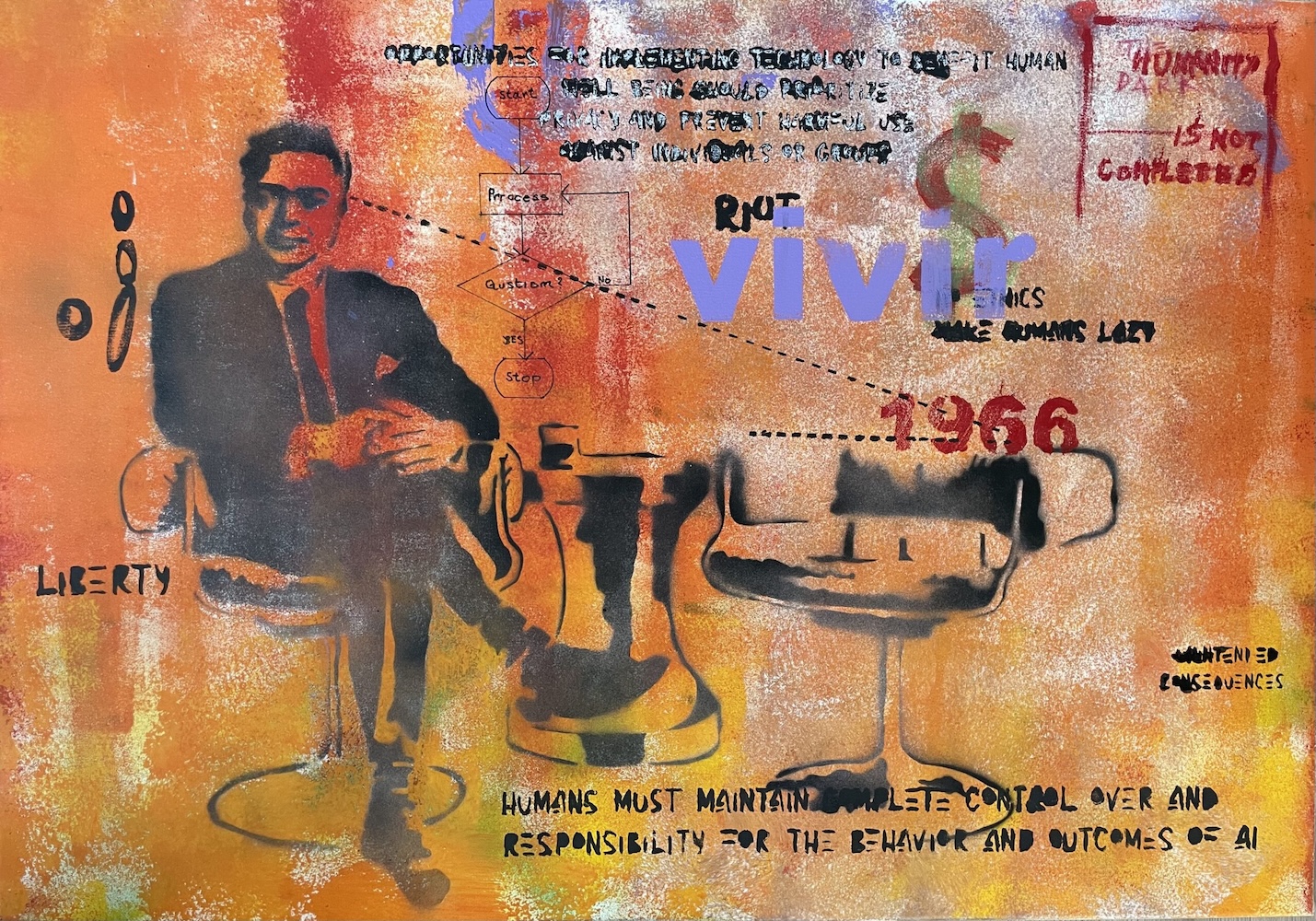
"Vivir Utopia" is a mixed-media piece that blends stencil art, spray paint, and text to create a thought-provoking commentary on technology, control, and human agency. The warm, fiery orange and red hues dominate the background, evoking urgency and intensity. A well-dressed man, stenciled in black, sits confidently in a chair, embodying authority or contemplation. His gaze, directed towards an empty chair, suggests a dialogue or confrontation—perhaps between humanity and artificial intelligence.
Flowchart-like diagrams, cryptic phrases, and digital-age references such as "HUMANS MUST MAINTAIN COMPLETE CONTROL OVER AND RESPONSIBILITY FOR THE BEHAVIOR AND OUTCOMES OF AI" add layers of meaning. The word "Vivir" (Spanish for "to live") stands out in bold, cool purple, contrasting with the fiery background.
The overall piece conveys a tension between human liberty, responsibility, and the accelerating forces of technology. This artwork is a compelling addition to modern interiors, stimulating conversation and deep reflection.
Visual Style & Technique
This painting is a fusion of street art, abstract expressionism, and conceptual futurism. The stencil technique and layered spray paint textures pay homage to urban graffiti and Banksy-like political art. The chaotic mix of text, color splashes, and structured diagrams gives it a postmodern, cyberpunk aesthetic, reminiscent of dystopian themes found in sci-fi literature and film.
Color & Symbolism
- Fiery orange and red background representing urgency, danger, and technological acceleration
- Cool purple "Vivir" text creating visual contrast and emphasizing hope amid chaos
- Black stenciled figure providing clarity and human grounding against abstract complexity
- Integrated diagrams and text functioning as visual language for digital-age discourse
Central Motif: The Figure in the Chair
- Well-dressed man representing human authority, contemplation, and decision-making power
- Confident posture suggesting both mastery and uncertainty in technological futures
- Empty chair across from him implying dialogue, debate, or confrontation with artificial intelligence
- Gaze directed outward creating engagement and questioning viewer complicity
Textual Elements & Layering
- The mandate "HUMANS MUST MAINTAIN COMPLETE CONTROL OVER AND RESPONSIBILITY FOR THE BEHAVIOR AND OUTCOMES OF AI" functions as both warning and policy statement
- Cryptic phrases and flowchart diagrams suggesting the complexity of AI governance and ethical frameworks
- Text operating as visual component equal to imagery, creating postmodern collage effect
- Multiple layers of meaning inviting repeated viewing and interpretation
AI Ethics & Human Responsibility
At its core, "Vivir Utopia" interrogates the fundamental question of our technological moment: Who controls artificial intelligence, and who bears responsibility for its actions? The prominent text declaration functions as both aspiration and warning, challenging viewers to consider whether humans truly maintain control or whether we have already surrendered agency to accelerating technological forces.
Dialogue Between Humanity & Technology
The composition depicts a conversation between the human figure and the absent (or implied AI) presence. This artistic choice raises profound questions about whether such dialogue is possible, whether it is balanced, and whether humanity can truly negotiate with technological systems that operate beyond our complete comprehension.
Liberation & Living (Vivir)
The Spanish word "Vivir"—meaning "to live"—represents freedom, agency, and authentic human existence. Its placement against the dystopian imagery suggests that true living requires maintaining human autonomy and conscious choice in technological systems. Utopia is not a destination but an ongoing practice of living meaningfully amid technological complexity.
Dystopian Urgency & Prophetic Warning
The chaotic color palette and fragmented composition convey a sense of temporal urgency. The artwork functions as a prophetic meditation on where our technological trajectory might lead if human oversight and ethical responsibility are abandoned. It is simultaneously warning and call to action.
Tension & Urgency
The vibrant, almost chaotic color palette evokes an impending crisis or a need for immediate awareness. The fiery oranges and reds create visceral unease, suggesting that the stakes of AI governance are not abstract but urgently present. The composition demands attention and response.
Reflection & Debate
The contrast between the controlled figure in the chair and the chaotic textual elements invites deep thought on the role of humans in shaping AI's future. Viewers are positioned as participants in an ongoing dialogue, not merely observers of technological change.
Fear & Responsibility
The text and imagery suggest both a warning and a call to action, challenging viewers to consider their role in technological evolution. There is underlying anxiety about loss of control, paired with determination that humans must actively maintain agency and ethical oversight.
Hope & Utopian Possibility
Despite the dystopian undertones and urgent crisis atmosphere, the word "Vivir" hints at the possibility of a better, more conscious future. The artwork suggests that utopia is not predetermined but constructed through human choice, ethical responsibility, and continued commitment to living authentically amid technological transformation.
Intellectual Provocation & Active Engagement
The density of symbols, text, and visual layers creates a richly complex emotional landscape that resists easy resolution. The artwork provokes intellectual debate, inviting viewers to become co-creators of meaning rather than passive consumers. This emotional engagement reflects the democratic possibility that humans can collectively shape technological futures.